Basement Painting Toronto: Colours, Finishes & Moisture Guide (2026)
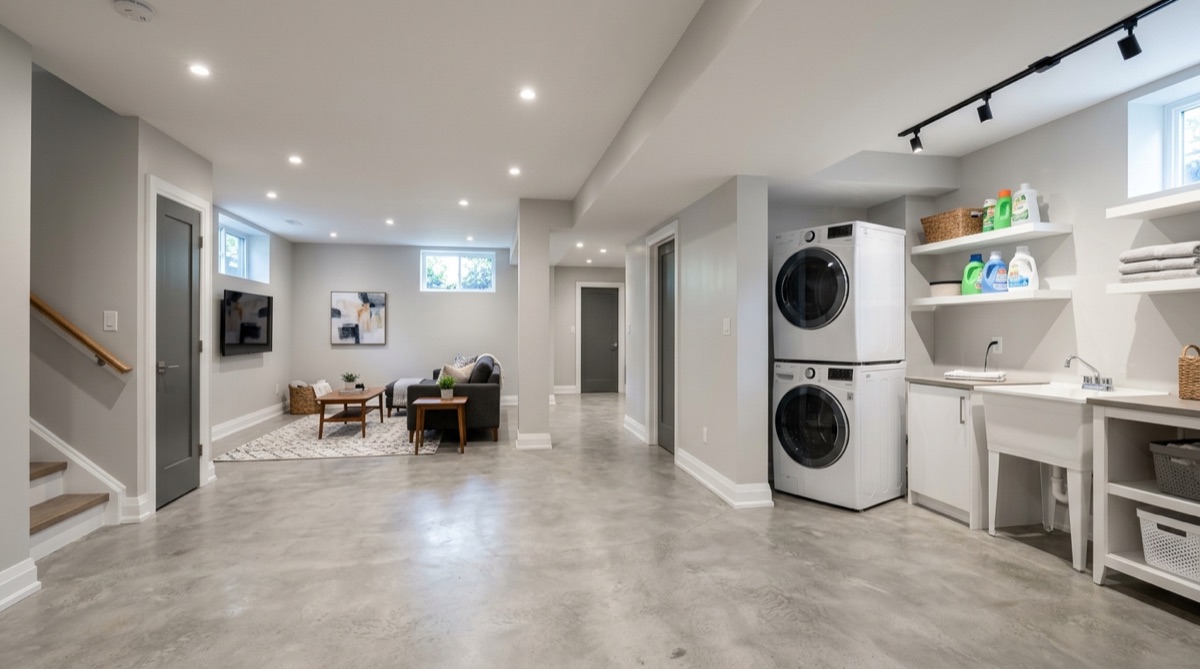
For Toronto basements: use a masonry sealer or alkali-resistant primer on all concrete surfaces, then apply two coats of semi-gloss or satin latex in a moisture-resistant formula. Address any active seepage before painting - paint will not stop water. Best colours for dark basements: Benjamin Moore White Dove, Pale Oak, or Balboa Mist. Typical cost: $800-$5,000+ depending on scope.
Basement painting in Toronto is fundamentally different from painting any other room in your home. Below-grade spaces deal with humidity migration through concrete, Ontario's freeze-thaw cycles, and - in older Toronto homes - the legacy of decades of varying waterproofing approaches. A paint job that would last 10 years upstairs might peel off concrete walls within two if the prep and product selection are wrong.
This guide covers what actually works: the right moisture prep sequence, how to choose between finishes, which colours perform well in low-light below-grade spaces, and what a realistic Toronto basement paint job costs in 2026.
Why Basements Require Different Treatment
Concrete and masonry walls are porous and alkaline. Moisture moves through them from the exterior - even when there's no visible leak - as vapour pressure drives water molecules through the wall mass. In Toronto, the freeze-thaw cycle (averaging 40-70 freeze-thaw events per winter in the GTA) puts additional stress on any coating applied to below-grade surfaces.
This means two things matter above everything else in a basement paint job: moisture source elimination and primer selection. Getting these wrong makes everything else irrelevant - even the best topcoat will fail within 12-24 months on a poorly primed or moisture-active surface.
Moisture Prep: Do This First
-
Identify and address active water sources
Check for efflorescence (white chalky deposits), water staining, or active seeps. These indicate hydrostatic pressure - exterior water pushing through the foundation. Fix grading, eavestroughs, and weeping tile issues before any painting. Paint cannot waterproof concrete.
-
Remove all efflorescence and existing flaking paint
Use a wire brush or angle grinder to mechanically remove any chalky deposits, loose paint, or friable surface material. Efflorescence must be fully removed - painting over it causes immediate adhesion failure.
-
Clean the surface thoroughly
TSP (trisodium phosphate) solution or a masonry cleaner removes oils, grease, and mineral deposits. Rinse completely and allow 24-48 hours drying time minimum before priming.
-
Apply a masonry sealer or alkali-resistant primer
DRYLOK Masonry Waterproofer, Benjamin Moore Fresh Start Masonry Primer (046), or Sherwin-Williams PrepRite Masonry Primer are proven choices. These penetrate the concrete pores and create an alkaline-resistant barrier. One coat on most surfaces; two coats on visibly porous or previously wet walls.
-
Allow full cure before topcoating
Masonry primers typically require 24 hours before topcoating, but 48 hours is safer in Toronto's humid summers. Rushing this step is the most common cause of adhesion failure on concrete.
Choosing the Right Finish
In a below-grade Toronto space, the finish choice is driven by two factors: moisture resistance and cleanability. Here's how the common finish levels compare for basement use:
Flat / Matte
Avoid in basements. Zero moisture resistance. Absorbs humidity, promotes mildew, and cannot be wiped down. Only acceptable on ceilings in dry finished basements.
Eggshell
Use with caution. Marginally more moisture-resistant than flat. Acceptable for finished basement living areas with good HVAC and humidity control. Not for laundry or bathroom areas.
Satin
Recommended for finished rec rooms, home offices, and living areas. Good moisture resistance, easy to clean, and lower sheen than semi-gloss so it's forgiving on imperfect drywall.
Semi-Gloss
Best for utility areas, laundry rooms, bathrooms, and directly on concrete. Highest moisture resistance, easy to wipe down, and withstands condensation and humidity swings.
For most Toronto basement projects, we use satin on drywall walls in finished living areas and semi-gloss on concrete, laundry rooms, and bathrooms. Ceilings in unfinished basements get flat or eggshell white. Ceilings in finished areas match the wall sheen level or go one step down.
Best Paint Products for Toronto Basements
Benjamin Moore Aura Bath & Spa (N534) is our top recommendation for basement walls with any moisture exposure. Its matte finish contains anti-mildew properties and performs significantly better than standard interior latex in below-grade conditions. For semi-gloss, Benjamin Moore Regal Select Semi-Gloss provides excellent adhesion and a hard, scrub-resistant surface. Both run approximately $90-$110 per gallon in Toronto.
Sherwin-Williams Emerald Interior Satin is a strong alternative - its advanced moisture resistance and scrubbability rating make it well-suited for Toronto basement humidity levels. For budget-conscious projects, Benjamin Moore ben Interior in satin performs adequately in finished areas with proper humidity control, at approximately $60-$75 per gallon.
Colour Picks for Toronto Basements
Below-grade spaces - especially those with small or no windows - require colours that read warm and bright under artificial light. Cool grey-whites that look crisp upstairs often read distinctly blue-grey in a windowless basement under LED lighting. Warm whites and soft warm neutrals consistently outperform.
Avoid Benjamin Moore's cool grey whites - Gray Owl, Stonington Gray, and Classic Gray - in dark basements. They all contain blue undertones that become pronounced under warm LED lighting in low-natural-light conditions. Similarly, Sherwin-Williams Repose Gray, despite its popularity in main floors, often reads too lavender-cool in windowless basements.
Basement Painting Costs in Toronto (2026)
| Project Type | Scope | Typical Cost |
|---|---|---|
| Unfinished utility basement | Concrete walls + ceiling, open layout, 600-800 sq ft | $800-$1,800 |
| Partially finished basement | Mix of drywall and concrete, basic trim, 700-1,000 sq ft | $1,500-$3,000 |
| Fully finished rec room | All drywall, full trim, one open space, 700-1,000 sq ft | $2,000-$3,500 |
| Full basement with multiple rooms | Bedroom, bathroom, rec room, laundry - all surfaces | $3,500-$6,000+ |
| Moisture remediation add-on | Efflorescence removal, skim coat, masonry sealer | $300-$1,200 |
Labour rates in Toronto currently run $40-$65 per hour for experienced painters. Materials on a typical finished basement add $200-$500 depending on paint brand selected and surface area. Projects requiring skim-coating over rough concrete, spray application, or significant repair work fall at the top of these ranges.
Common Basement Painting Mistakes
-
❌
Painting over active moisture. The most costly mistake. Water will push any coating off concrete from behind - often within months. Fix the source before touching a brush.
-
❌
Skipping masonry primer on concrete. Standard interior primer is alkaline-sensitive and will fail on concrete within 12-24 months. Masonry-specific primer is non-negotiable on any below-grade concrete surface.
-
❌
Using flat or eggshell paint in moisture-prone areas. Low-sheen finishes trap moisture, promote mildew growth, and cannot be wiped down. Semi-gloss minimum for any area near laundry, bathroom, or raw concrete.
-
❌
Choosing cool grey colours without testing first. What looks perfect on a paint chip reads blue-grey in a windowless basement under artificial light. Always test on the actual surface under the actual lighting before committing to colour.
-
❌
Rushing primer dry time. Masonry primer requires a full cure before topcoating. Applying a topcoat within 12 hours - common when crews try to do everything in one day - leads to poor adhesion and early peeling.
Get a Basement Painting Quote in Toronto
Next Day Painting handles basement projects of all types - unfinished concrete, fully finished rec rooms, and everything in between. We use moisture-appropriate primers on all concrete and masonry surfaces, and our workmanship is backed by a written warranty.
Get a Free QuoteCeiling Painting in Basements
Unfinished basement ceilings - exposed joists, pipes, and ductwork - are typically painted with flat black or flat white spray, which visually recedes the mechanical elements and gives an intentional industrial look. Flat black is currently the more popular choice in Toronto renovation circles; flat white makes the space feel brighter but requires more meticulous masking.
Finished basement ceilings with drywall are painted to match or one sheen step below the walls. For low ceilings (7-8 feet, common in Toronto semi-detached homes with basements), matching the ceiling colour to the walls and going slightly lighter on trim helps the space feel taller and less compressed.
For more detail on the full interior painting process and what to look for when hiring, see our complete interior painting guide.
Frequently Asked Questions
Semi-gloss or satin are the best finishes for Toronto basements. Both resist moisture and humidity better than eggshell or flat paint, and both clean more easily - important in a space that may see laundry, storage, or recreational use. Semi-gloss is ideal for utility areas, laundry rooms, and bathrooms; satin is better for finished living areas where you want warmth without a high sheen. Flat or matte paint should be avoided entirely in below-grade spaces.
Yes - priming concrete is mandatory, not optional. Bare concrete is alkaline, porous, and absorbs moisture from both sides. A masonry sealer or alkali-resistant primer (such as DRYLOK or Benjamin Moore Fresh Start Masonry Primer) creates a barrier against moisture wicking and ensures the topcoat bonds properly. Skipping primer is the single most common reason basement paint peels within 12-24 months in Toronto's climate.
Basement painting in Toronto typically costs $800-$1,800 for an unfinished utility basement (concrete walls and ceiling), $1,500-$3,000 for a partially finished basement with drywall and trim, and $2,500-$5,000+ for a fully finished basement with multiple rooms, built-ins, and detailed trim work. Moisture remediation or skim-coating before painting adds cost. Most Toronto painters charge $40-$65 per hour for labour.
Light, warm neutrals work best for dark below-grade spaces. Benjamin Moore White Dove (OC-17), Chantilly Lace (OC-65), and Pale Oak (OC-20) are consistently popular Toronto basement choices - they reflect available light without reading cold or sterile. For finished rec rooms and home offices, Benjamin Moore Balboa Mist (OC-27) and Sherwin-Williams Accessible Beige (SW 7036) add warmth while keeping the space feeling open. Avoid cool grey-whites in north-facing or windowless basements - they read blue under artificial light.
Yes - painting over active moisture is one of the most common and costly basement painting mistakes. If you see efflorescence (white chalky deposits), water stains, or peeling paint on concrete walls, these are signs of hydrostatic pressure or active seepage. Paint will not stop water - it will simply peel again. Address the source of moisture first (exterior grading, eavestroughs, weeping tile) before any painting is done. In Toronto's freeze-thaw climate, unaddressed moisture issues almost always worsen over winter.